Can I use less butter?
You can, but the buttercream will be softer and less suitable for filling/frosting cakes.

Are you a big fan of meringue, or do you really dislike the buttery taste of traditional buttercream or ermine frosting? Then this Swiss meringue buttercream recipe absolutely deserves a spot in your collection!

Whenever I needed a buttercream for cupcakes or cake fillings, I would typically reach for my ermine frosting which is a basic vanilla buttercream using flour. Because of that, the taste is not buttery (in my opinion).
However this Swiss meringue buttercream is beautifully airy and silky smooth. Plus it doesn’t require any flour either, making it naturally gluten-free.
I still love my recipe for ermine frosting, but since I made Swiss meringue buttercream for the first time… well, this is my favorite buttercream ever!

To make this recipe, you really only need 4 simple ingredients. In addition, it helps to make this in the bowl of a stand mixer fitted with the whisk attachment. Of course a hand mixer is a good option too. Check the recipe card below for full details.
Swiss meringue is what’s called a cooked meringue. This means you heat the egg whites and sugar over a bain-marie (double boiler) until they reach the right temperature, then whip them to stiff peaks.
The result is a firmer, more stable meringue than French meringue, perfect for turning into a sturdy buttercream that you can use to fill and frost cakes or pipe tall swirls onto cupcakes.
You’ll find this cream under several names online. In the US, it’s called Swiss meringue buttercream or SMBC for short.
The Dutch translation is “Zwitserse meringue botercrème,” but you’ll also see it simply referred to as Swiss buttercream or meringue buttercream.
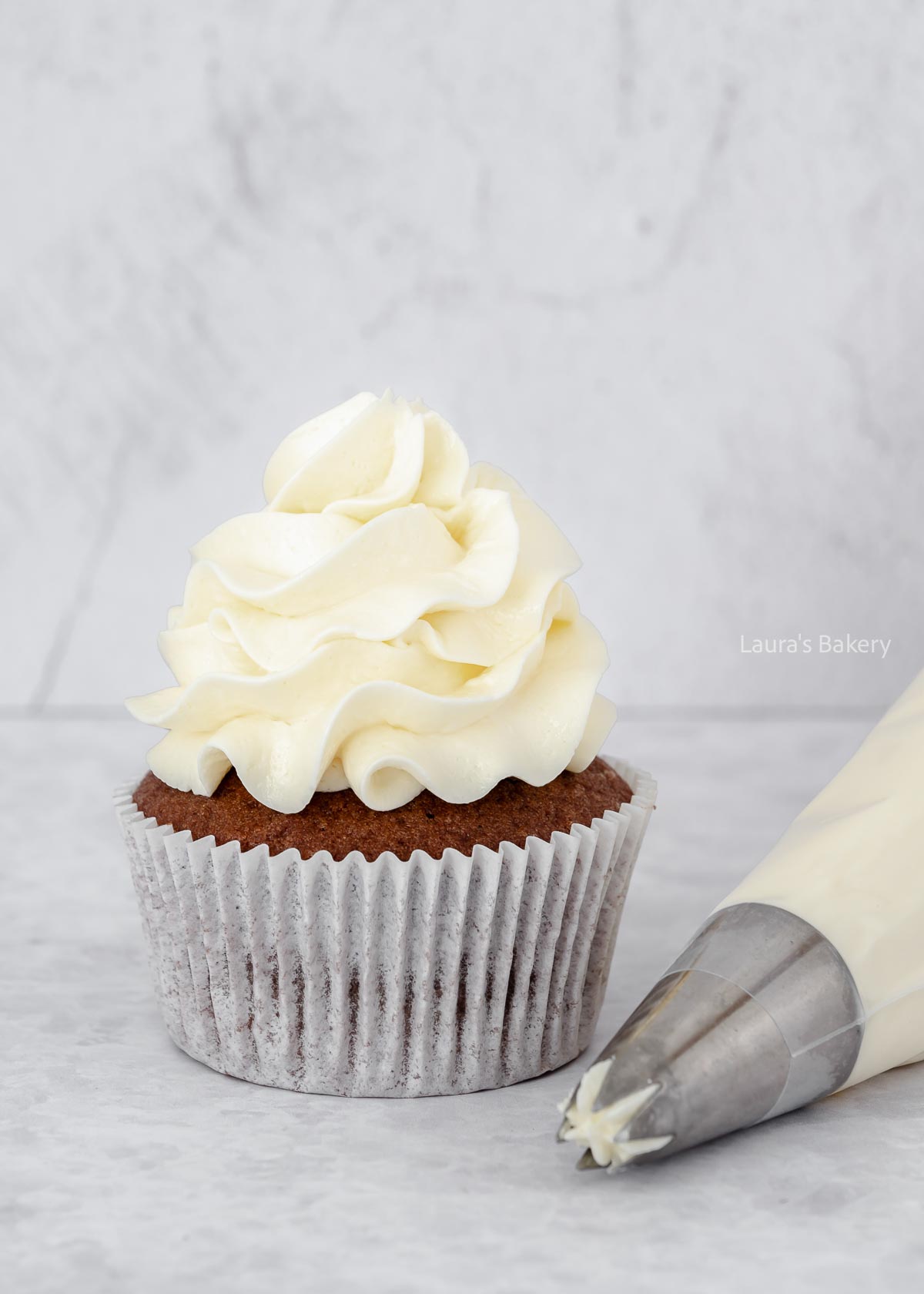
Buttercream is such a baking classic; creamy, fluffy and endlessly customizable. Whether you want a basic recipe or a fun flavor twist, there’s always a buttercream that perfectly suits your cake or cupcakes.
I’ve written a couple of articles on how to make the most out of your buttercream:
When you heat the egg whites over a bain-marie, they typically reach a temperature between 130°F and 160°F (55-70°C). To fully eliminate harmful bacteria, the mixture needs to stay at 160°F (70°C) for at least 5 minutes. Use a thermometer to check.
If you don’t have a thermometer or want to be extra cautious, use pasteurized egg whites from the grocery store.
Another option is to make Italian meringue buttercream instead. With that method, hot sugar syrup is streamed into the egg whites while whipping, also killing bacteria.
Just note that in this case, it becomes Italian meringue buttercream, not Swiss. Use half a batch of Italian meringue if you go that route.
Just like my vanilla buttercream/ermine frosting this meringue buttercream stores very well, which is ideal if you’re prepping ahead for a party.
I prefer to assemble cakes last-minute, but I prepare the individual elements in advance and store them in airtight containers.
Refrigerator: 3-4 days in an airtight container
Freezer: Up to 3 months in an airtight container
Thaw frozen buttercream in the fridge for 24 hours to prevent curdling. After thawing, re-whip until smooth and fluffy again.

You can, but the buttercream will be softer and less suitable for filling/frosting cakes.
No, the sugar amount is necessary for a stable meringue structure.
Curdling usually happens due to a temperature difference between ingredients:
Place the mixing bowl in a warm water bath and whip until the mixture emulsifies again or use a warm hairdryer aimed at the outside of the mixer bowl while whipping
Both methods help bring everything back to the same temperature so it can come together smoothly.
About 16-20 cupcakes, depending on swirl size.
This recipe is enough to generously fill a 20 cm (8-inch) cake twice.
Links in this article may be affiliate links. If you purchase something through such a link, I will receive a small commission, without you paying anything extra.

Welcome to Laura’s Bakery! You’ve come to the right place for the most delicious baked goods and appetizers. With my easy recipes for home bakers I will show you that baking is fun and delicious.
Have fun baking!